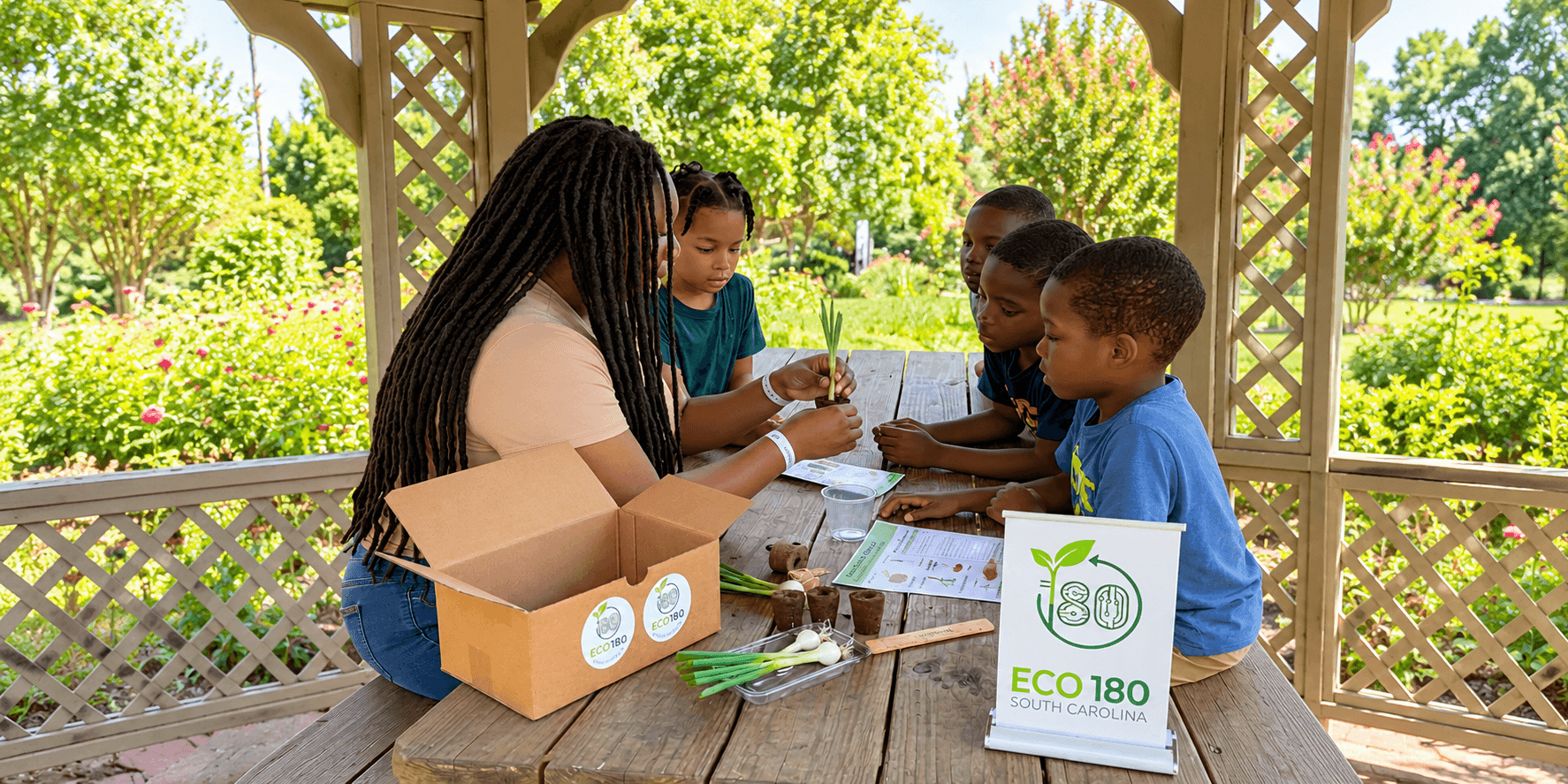
ECO 180 brings smart agriculture, STEM education, and environmental learning to South Carolina youth through sponsorships and community support.
For many young people across South Carolina, opportunities to explore advanced agricultural science and technology remain limited. Yet a simple classroom experiment involving plants, fish, and water can introduce students to an entirely new world of possibilities. This is the vision driving ECO 180, a South Carolina nonprofit founded by Jasmine Singh. Through agricultural education, environmental stewardship, and modern technology, the organization is working to provide minority youth and underserved communities with practical learning experiences that can inspire future careers and strengthen community connections.
ECO 180 Is Expanding Agricultural Education Across South Carolina
Guided by its mission of Learn, Measure, Participate, ECO 180 aims to change how young people understand agriculture, science, and environmental responsibility.
Although headquartered in the Midlands, the nonprofit's mission spans all 46 South Carolina counties, including the Upstate, Midlands, Lowcountry, and Pee Dee regions. Its statewide approach focuses on developing partnerships with schools, community organizations, corporate sponsors, and grantmakers to expand educational access.
"ECO 180 is built for all of South Carolina. While our headquarters and Living Agricultural Laboratory are in the Midlands, our mission spans from the Upstate to the Lowcountry. Every grant and sponsorship we receive allows us to directly target and deploy programs where the funding is needed most," says Jasmine Singh, Founder and Executive Director of ECO 180.
Rather than relying on conventional agricultural instruction, ECO 180 introduces students to controlled environment agriculture, aquaponics, plant propagation, and digital technology.
Bringing Agricultural Science Into Classrooms Through STEM Ag Kits
One of ECO 180's core initiatives is its sponsor funded STEM Ag Kit program, designed to bring interactive agricultural education directly to students.
The organization offers two specialized educational pathways.
The Aquaponics STEM Kit introduces students to recirculating ecosystems where fish, beneficial bacteria, water, and plants interact. Students explore biological relationships, water chemistry, and sustainable food production through practical observation.
The Plant Propagation STEM Kit focuses on plant anatomy, genetics, reproduction, and root development. Students learn how plants grow from seeds and how propagation techniques can produce new plants.
For younger learners, ECO 180 also offers Junior Farm to Home activities featuring green onion regrowth and observation journals. These activities introduce children beginning at the 4K level to scientific observation and plant development.
Through sponsorship support, ECO 180 aims to provide these resources to participating classrooms, homeschool groups, and community programs at no cost to educators.
The nonprofit has established a goal of distributing 400 sponsored STEM Ag Kits annually, targeting 100 kits across each of South Carolina's four major regions. Achieving this goal will depend on available grants, donations, and sponsorship commitments.
For sponsors, these programs provide an opportunity to support accessible, practical science education while helping students discover new interests and skills.
Connecting Students With Smart Farming And AI Literacy
ECO 180 also seeks to prepare young people for an agricultural industry increasingly shaped by digital technology.
Through its GroundTruth AI and sensor literacy initiative, the organization introduces students ages 10 to 19 to environmental monitoring, data interpretation, and responsible artificial intelligence.
Students explore how sensors measure water pH, dissolved oxygen, temperature, and other environmental conditions. Digital dashboards help demonstrate how collected information can support decisions in aquaponics and controlled environment agriculture.
Importantly, ECO 180 emphasizes that technology should complement human judgment. Students are encouraged to verify data, question automated interpretations, and understand the scientific reasoning behind agricultural decisions.
"We are creating a complete 180 degree shift in how our youth view agriculture. Farming isn't just a memory of the past. It is a modern, tech driven career that holds the key to food security, environmental justice, and economic empowerment across our entire state," Singh explains.
By connecting agricultural education with science, technology, engineering, arts, and mathematics, ECO 180 hopes to introduce students to careers in environmental science, agricultural engineering, data analysis, and sustainable food production.
Developing The Rembert Living Agricultural Laboratory
A major part of ECO 180's future vision is the development of its Living Agricultural Laboratory in Rembert, South Carolina.
The planned facility is intended to serve as a smart aquaponics learning environment where students can connect classroom lessons with larger agricultural systems.
Its proposed features include integrated fish and plant production, water monitoring sensors, environmental data technology, and practical educational activities.
The laboratory remains in its development and fundraising phase. ECO 180 is actively seeking financial contributions, equipment sponsorships, and organizational partnerships to support construction and implementation.
The organization envisions the laboratory as an educational resource that can demonstrate controlled environment food production while supporting its broader community food access goals.
"Building our Living Agricultural Laboratory in Rembert is about scaling real impact across South Carolina. When supporters donate to our aquaponics buildout or sponsor classroom kits, they are investing in young leaders who will protect our water, feed our communities, and lead the future of smart farming," Singh says.
For potential donors and corporate partners, the project offers an opportunity to support the development of agricultural education infrastructure designed to benefit future generations.
Advancing Agricultural Equity And Environmental Responsibility
Beyond classroom instruction, ECO 180 is committed to expanding agricultural opportunities for minority youth and underserved communities.
Black farmers represent a small percentage of agricultural producers nationwide, reflecting longstanding challenges involving access to agricultural resources and opportunities.
ECO 180 seeks to help address this gap by introducing students to modern agricultural careers and showing how technology can create new pathways into the field.
The nonprofit also connects education with environmental stewardship through its Clean Community Incentive, an initiative focused on restoring neglected neighborhoods affected by pollution, illegal dumping, and environmental hazards.
Together with its community food access objectives, these efforts reflect ECO 180's commitment to connecting scientific knowledge with community needs.
Supporting ECO 180 Through Sponsorships And Donations
As ECO 180 works toward expanding its statewide educational programs, support from businesses, foundations, community organizations, and individual donors remains central to its plans.
Sponsorships can help provide Aquaponics and Plant Propagation STEM Kits to students, support educational outreach, and expand access to agricultural technology.
Donations and equipment partnerships can also help advance the Rembert Living Agricultural Laboratory, including its proposed aquaponics systems, monitoring equipment, and educational infrastructure.
For supporters interested in youth development, agricultural innovation, and environmental stewardship, ECO 180 offers several ways to explore meaningful involvement.
Each contribution can help the organization pursue its mission of making practical agricultural education more accessible to young people throughout South Carolina.
Explore How You Can Support ECO 180's Mission
ECO 180 is working toward a future where more young people can explore modern agriculture, understand environmental challenges, and discover careers shaped by science and technology.
From its two specialized STEM Ag Kits to its developing Living Agricultural Laboratory, the organization is building educational pathways that connect classroom curiosity with practical experience.
Its continued growth will depend on partnerships with those who recognize the value of accessible education and stronger community resources.
Businesses, foundations, and individuals interested in learning about sponsorship opportunities, supporting educational kits, or contributing to the Rembert laboratory development can visit www.eco180.org.
Potential sponsors and donors can also contact growth@eco180.org.
Through community collaboration and continued support, ECO 180 hopes to help more South Carolina students discover the possibilities of agricultural science and participate in shaping a more sustainable future.

The Leader Report Contributor
Grace Patterson
Covers business, leadership, entrepreneurship, and noteworthy professionals across a range of industries.
This article features partner, contributor, or branded content from a third party. Members of the The Leader Report editorial staff were not involved in the creation of this content. All views and opinions are those of the contributor alone.
You may also like

How Josselyne Herman-Saccio Uses The Power Of Language To Create Meaningful Change

HomePro Mobility: Keeping People Safely at Home

How Jichél Stewart Helps Professionals Build Authority Beyond Their Job Titles

From Vision to Execution: Shola Ajibade's Blueprint

Address Only: The Signage That Could Save a Life