
Phanuella Djanteng champions women as decision makers in Congo Basin forest governance through Global Forest Watch and WRI leadership.
Phanuella Djanteng recalls attending a forest governance meeting early in her career where technical data, satellite maps, and policy frameworks guided the discussion. What stood out to her was not what was said, but who was absent. The women who cultivated nearby land, gathered forest products, and sustained household economies were not represented in the room. That realization became a defining influence on her professional path.
Today, as Congo Basin Engagement Associate for Global Forest Watch at the World Resources Institute (WRI), Phanuella contributes to strengthening inclusive forest governance across Central Africa. Her work emphasizes that women are not only participants in forest-based livelihoods, but essential stakeholders in the decisions that shape how forests are managed.
A Professional Path in Environmental Science
Choosing environmental science was not the most conventional route. In parts of Central Africa, forestry and environmental monitoring have traditionally been male-dominated sectors, often associated with timber operations and field enforcement. Entering this space required both technical competence and determination.
Phanuella pursued formal training in environmental science, developing expertise in forest monitoring and governance systems. Over time, her field experience deepened her perspective. She observed that forests function not only as ecological systems, but also as food sources, income generators, and community safety nets.
Forests in the Congo Basin support agricultural production, non-timber forest products, and local markets. In many communities, women play central roles in managing these resources. Yet formal governance mechanisms, such as land-use planning discussions and forest revenue allocation processes, have not always reflected that reality.
Women in Forest Governance in the Congo Basin
The Congo Basin contains the world’s second-largest tropical rainforest and contributes significantly to global climate regulation and biodiversity conservation. Global Forest Watch, an initiative of WRI, provides accessible forest monitoring data to governments, civil society organizations, researchers, and communities. The platform promotes transparency by making satellite-based forest data publicly available.
Phanuella’s work focuses on ensuring that access to information supports inclusive decision-making. Transparency alone does not guarantee participation. A key question guiding her engagement is who uses forest data and who influences the policy decisions that follow.
Across forest landscapes in Central Africa, women are deeply involved in farming, collecting fuelwood, harvesting non-timber forest products, and supporting household economies. Their daily interaction with forest ecosystems provides practical knowledge about seasonal patterns, resource management, and community needs.
When governance systems exclude these perspectives, policies may overlook critical social and economic dynamics. Broader inclusion can strengthen both equity and environmental outcomes by incorporating a wider range of local insights into planning and oversight processes.
Bridging Data and Community Dialogue
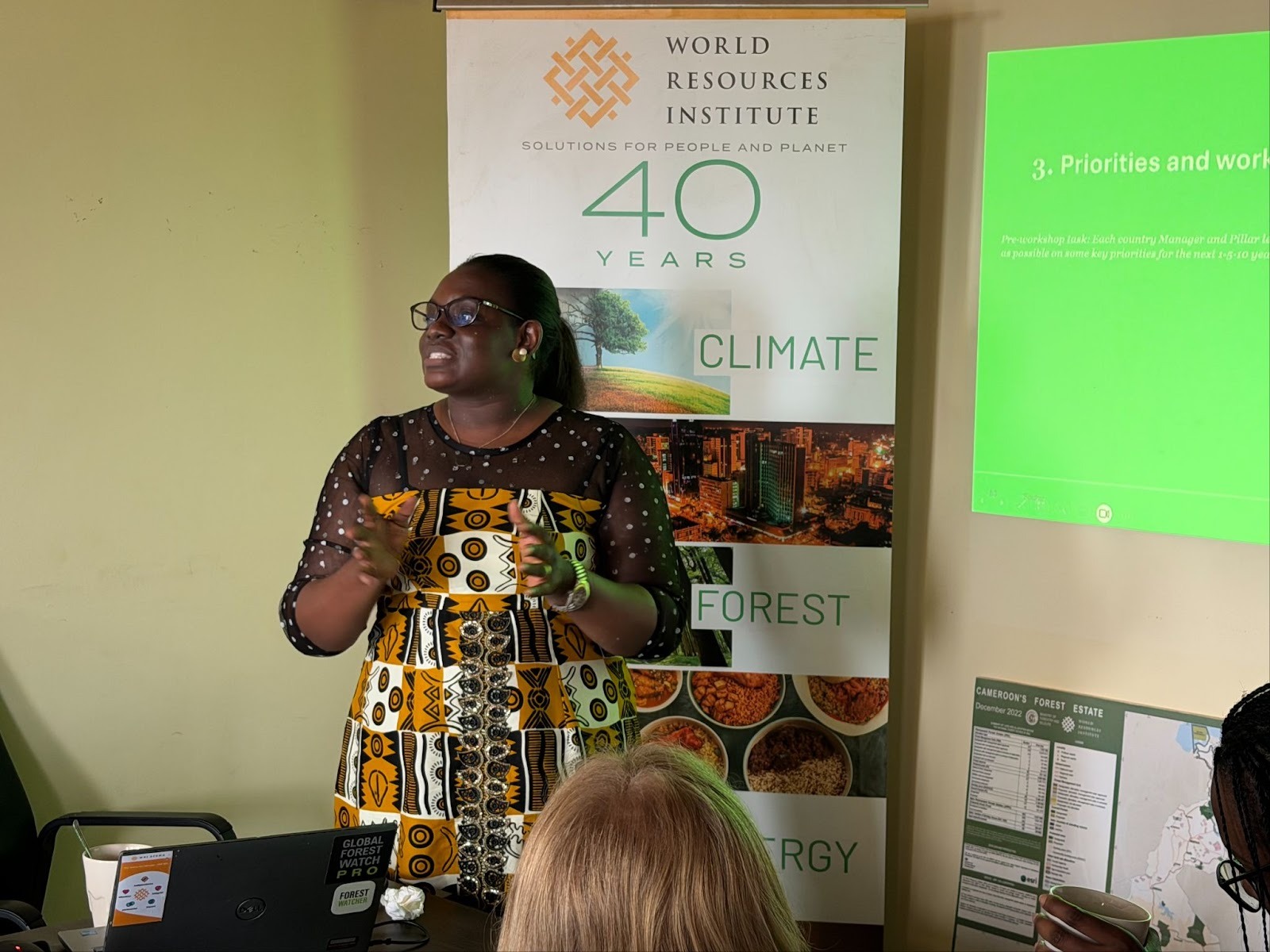
Working within a technical and historically male-dominated sector requires credibility grounded in expertise. Phanuella supports stakeholders in understanding and applying Global Forest Watch data to real-world governance discussions. Her role involves facilitating dialogue among institutions, civil society actors, and community representatives to promote informed decision-making.
By translating complex monitoring data into accessible insights, she helps ensure that forest information is not limited to national-level institutions but can also inform conversations at regional and local levels. This approach supports accountability and encourages collaborative governance models.
Forest revenues, for example, can influence investments in community services and development initiatives. Inclusive participation in revenue discussions can broaden the range of priorities considered and enhance transparency in how resources are allocated.
Inclusion as a Structural Consideration
In the context of environmental governance, inclusion involves more than representation at meetings. It requires access to information, clear procedures, and institutional frameworks that enable meaningful participation. Strengthening these structures can help ensure that decision-making processes reflect the diversity of those whose livelihoods are connected to forest landscapes.
Phanuella’s work sits at the intersection of research, technology, and community engagement. Through regional collaboration and institutional partnerships, she contributes to efforts aimed at making forest governance systems more transparent and responsive.
Sustainable forest management benefits from incorporating diverse perspectives. Women are already central to how forests support families and local economies. Recognizing and integrating that reality within governance structures can enhance policy design and long-term conservation strategies.
For more information, visit:
World Resources Institute: WRI Africa
Phanuella Djanteng on LinkedIn: https://www.linkedin.com/in/phanuella-djanteng/