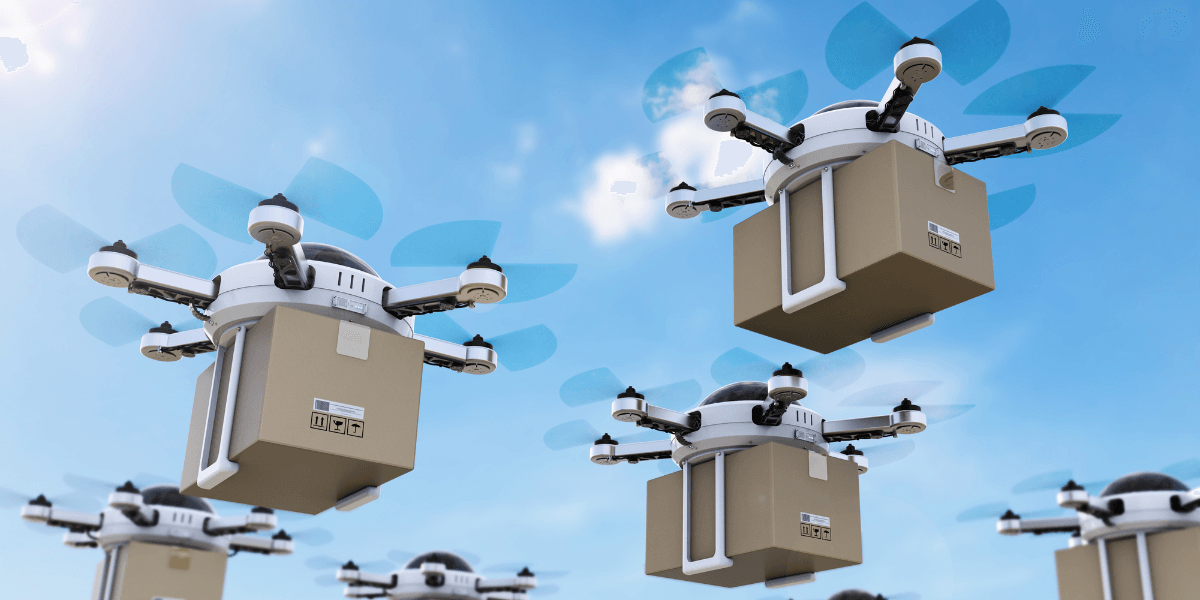
Uber's agreement with Zipline announced Monday demonstrates how a major technology platform is using partnership and investment to expand into autonomous logistics without building an entire drone-delivery operation internally.
The companies said Zipline's autonomous aircraft will begin making Uber Eats deliveries later in the year in existing Zipline markets, with expansion planned for dozens of U.S. cities. Their long-term target is one million drone deliveries per day by the end of 2029.
Uber will also make a strategic investment in Zipline, although the size of the investment was not disclosed.
A partnership built around complementary capabilities
The strategic logic is relatively straightforward.
Zipline brings autonomous aircraft, logistics expertise and an existing delivery network. Uber brings a large consumer marketplace, merchant relationships and the Uber Eats platform.
Neither company needs to duplicate the other's core capabilities.
For Uber, the arrangement provides access to drone technology without requiring the company to build an aircraft manufacturer and autonomous-flight network from scratch. For Zipline, the partnership provides access to a major consumer ordering platform.
That division of responsibilities illustrates a broader corporate strategy increasingly used in technology: combining specialized capabilities through partnerships rather than attempting to control every layer of a new market.
Investment reinforces the relationship
The financial component is also strategically important.
Uber is not merely adding Zipline as another service provider. Its investment creates a deeper relationship between the companies while maintaining separate corporate operations.
The investment amount was not disclosed, so its financial significance cannot be independently assessed from the announcement.
Nevertheless, the structure shows how established companies can use minority or strategic investments to align themselves with emerging technologies while limiting the need for full acquisition.
Autonomous technology as a platform strategy
Uber's approach extends beyond drones.
The company has increasingly partnered with outside autonomous-technology providers rather than attempting to develop every technology itself. TechCrunch noted that the company has used similar strategies in autonomous vehicles and other emerging transportation technologies.
The strategy can provide flexibility.
Autonomous technology is developing quickly, and different providers may specialize in different forms of transportation. A platform company can potentially connect customers to multiple providers while maintaining control of the customer experience.
That model can also reduce the risk associated with committing all resources to a single technological approach.
Scaling is the strategic challenge
The partnership's biggest challenge will be moving from initial deployments to meaningful scale.
Zipline and Uber are targeting one million daily drone deliveries by the end of 2029, but the first deliveries will begin only in existing Zipline markets.
Expansion to dozens of cities will require operational consistency across different environments.
The companies will need to manage aircraft operations, delivery locations, customer interfaces and local requirements while ensuring that the service remains commercially viable.
A strategic target is therefore not the same as an achieved outcome. The coming deployments will provide evidence about whether the model can scale.
Speed is part of the value proposition
Zipline said its drones can deliver orders in roughly five to 10 minutes.
That speed is strategically relevant because last-mile delivery is one of the most difficult and expensive parts of consumer commerce.
Road-based delivery can be slowed by traffic, parking and driver availability. Autonomous aircraft offer an alternative route for certain types of orders.
The technology will not eliminate conventional delivery. Instead, it could create another delivery layer that handles selected orders where drone operations make economic and operational sense.
What leaders can learn from the move
The Uber-Zipline agreement provides a documented example of partnership-based innovation.
Uber is combining an existing distribution platform with an external technology provider that has already built operational capabilities. The investment creates additional alignment without requiring an outright acquisition.
That approach may become increasingly common as companies seek to adopt artificial intelligence, robotics and autonomous systems.
Technology adoption does not always require ownership of every underlying component. In many cases, the competitive advantage can come from integrating specialized technologies into a widely used platform.
Why the strategy matters
The agreement matters because it shows how autonomous technology is becoming a corporate strategy issue rather than simply an engineering experiment.
Uber's move connects investment, partnerships, logistics and platform expansion in a single decision.
The long-term success of the strategy will depend on execution, market adoption and the ability to scale operations efficiently.
For business leaders, however, the immediate significance is already clear: emerging technology can increasingly be commercialized through carefully structured partnerships that combine existing customer networks with specialized technical capabilities.
That makes the Uber-Zipline agreement an example of a broader shift in corporate innovation—one in which strategic integration may matter as much as technological invention itself.

The Leader Report Contributor
Grace Patterson
Covers business, leadership, entrepreneurship, and noteworthy professionals across a range of industries.
This article features partner, contributor, or branded content from a third party. Members of the The Leader Report editorial staff were not involved in the creation of this content. All views and opinions are those of the contributor alone.
You may also like

The Revenue Brian Muldoon Says Is Already Yours

HomePro Mobility: Keeping People Safely at Home

How Jichél Stewart Helps Professionals Build Authority Beyond Their Job Titles

Rodrigo Coll Palma: Redefining Aesthetic Medicine

From Vision to Execution: Shola Ajibade's Blueprint