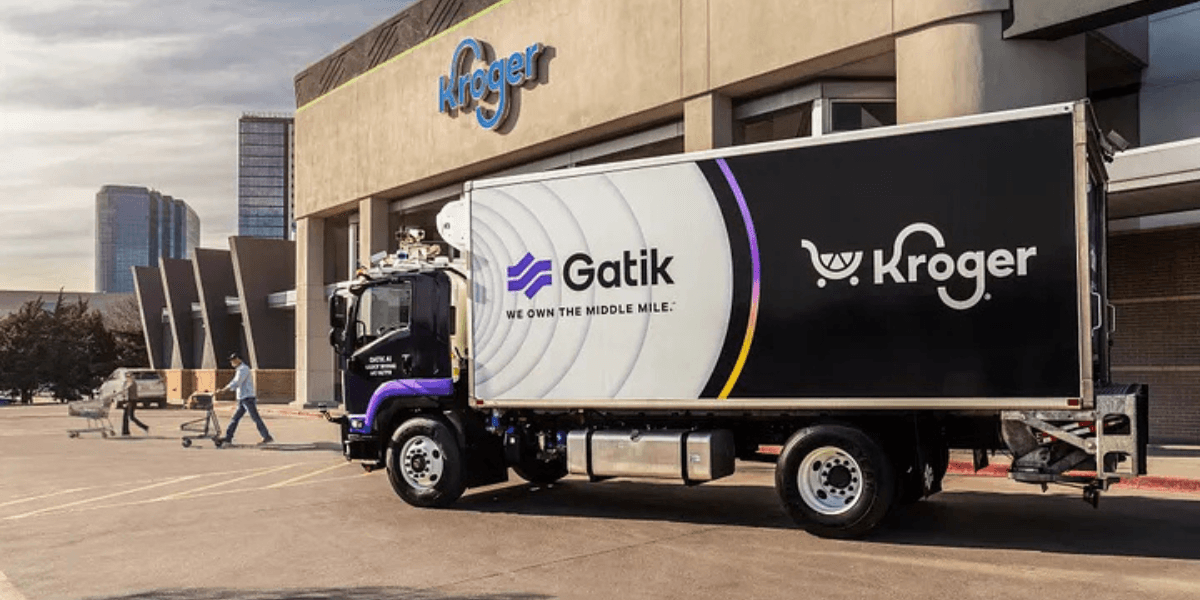
Autonomous trucking startup Gatik announced a $200 million Series D financing round Tuesday, giving the California-based company additional capital to expand its driverless freight operations across North America.
The financing was led by Qatar Investment Authority and Koch Disruptive Technologies, with participation from Millennium Management, ARK Invest and Intact Private Capital.
Gatik said the new capital will support expansion of its commercial operations, technology, infrastructure and workforce as demand grows for autonomous freight services.
From pilots to commercial freight
Gatik focuses on autonomous trucking for regional freight routes.
Rather than operating passenger robotaxis, the company moves goods between distribution centers and retail locations.
That business model addresses a specific logistics problem: transporting products repeatedly between fixed locations.
The company says it has completed 85,000 fully driverless orders and has more than $600 million in contracted revenue.
Those figures illustrate the company's attempt to move autonomous trucking beyond experimental deployments.
The $200 million round
The Series D financing provides Gatik with substantial capital to expand.
The company said the funding will support its commercial operations, fleet expansion, technology development, infrastructure and workforce.
Gatik is targeting more than 100 driverless trucks by the end of the year, according to Reuters.
The scale of that target is significant because autonomous freight requires more than the vehicles themselves.
Companies must develop software, mapping systems, remote support, maintenance capabilities and operational infrastructure.
Why freight is an early autonomous market
Autonomous trucking can be particularly suited to repetitive regional routes.
A truck traveling between a distribution center and a store can follow a predictable network of roads.
The route can be mapped and monitored repeatedly.
That is different from autonomous passenger transportation, where vehicles must handle unpredictable destinations and highly variable passenger environments.
The predictable nature of freight routes can make them attractive for early commercial deployment of autonomous technology.
Customers are driving demand
Gatik operates in supply chains serving major retailers and consumer-goods companies.
Its network includes operations in Texas, Arizona and Arkansas, as well as Canada.
The company has also entered a multiyear partnership with PepsiCo.
Such relationships are important because autonomous trucking companies need commercial customers willing to incorporate driverless vehicles into real logistics operations.
The workforce question
Autonomous trucking is often discussed in terms of potential effects on professional drivers.
The technology could eventually change the number and type of workers required to move freight.
However, autonomous logistics also creates new roles involving fleet management, remote operations, maintenance, software engineering and safety systems.
The transition is therefore likely to involve changes in workforce composition rather than a simple replacement of one job with a machine.
Supply chains are changing
Retailers and manufacturers increasingly seek faster and more predictable movement of goods.
Distribution centers must replenish stores efficiently.
Unexpected transportation delays can affect inventory and customer availability.
Autonomous freight could provide additional capacity on high-frequency routes.
If the technology can operate reliably, companies may eventually be able to move goods with greater scheduling flexibility.
Safety remains central
Commercial deployment also requires strict attention to safety.
Autonomous trucks must operate around conventional vehicles, pedestrians, construction zones and changing road conditions.
Companies need systems capable of detecting hazards and responding appropriately.
Gatik's commercial expansion therefore depends on proving that its technology can operate reliably outside controlled testing environments.
Financing the next phase
The $200 million financing gives Gatik the resources to pursue larger-scale operations.
For a startup, that can be particularly important because autonomous technology requires substantial capital before it reaches broad commercial scale.
Vehicles, sensors, software development, testing and operational infrastructure all require investment.
The financing also gives the company greater capacity to respond to demand from commercial customers.
Competition is increasing
Gatik is operating in a rapidly developing autonomous freight industry.
Other companies are also developing driverless trucks and logistics systems.
The competitive advantage will likely depend on a combination of technology, safety performance, customer relationships and the ability to operate economically at scale.
Funding alone does not guarantee success.
Companies must demonstrate that autonomous freight can produce reliable commercial results.
Why the development matters
Gatik's $200 million Series D financing is significant because it signals continued investor interest in autonomous freight as the technology moves toward larger commercial operations.
The company has already completed tens of thousands of fully driverless orders and is targeting more than 100 autonomous trucks by the end of the year.
For startup founders, the development demonstrates the scale of capital required to move complex physical technologies from testing into commercial deployment.
For the logistics industry, it provides another indication that autonomous trucking is becoming a practical business proposition rather than simply a research project.
The next test will be whether Gatik can translate its funding and existing customer relationships into sustained, large-scale autonomous freight operations.

The Leader Report Contributor
Taylor McKenzie
Covers entrepreneurship, careers, technology, and the changing ways people build businesses and professional identities.
This article features partner, contributor, or branded content from a third party. Members of the The Leader Report editorial staff were not involved in the creation of this content. All views and opinions are those of the contributor alone.
You may also like

HomePro Mobility: Keeping People Safely at Home

How Jichél Stewart Helps Professionals Build Authority Beyond Their Job Titles

Rodrigo Coll Palma: Redefining Aesthetic Medicine

The Revenue Brian Muldoon Says Is Already Yours

From Vision to Execution: Shola Ajibade's Blueprint