
The EU AI Act is creating demand for AI governance experts, opening career opportunities reminiscent of the GDPR revolution.
When the General Data Protection Regulation (GDPR) came into force in 2018, few predicted it would create an entirely new profession. Almost overnight, organisations were searching for privacy experts, compliance officers, consultants, auditors and data protection specialists. Professionals who understood GDPR found themselves in extraordinary demand while businesses competed for scarce talent.
A similar shift is now underway.
The European Union AI Act, the world’s first comprehensive law governing artificial intelligence, entered into force in August 2024. Since then, key provisions have been introduced in stages, with prohibitions taking effect in February 2025 and obligations for general-purpose AI models following in August 2025. On 2 August 2026, another major milestone arrived as enforcement powers came into effect, allowing the European Commission to issue fines against general-purpose AI providers while new transparency obligations and national penalty frameworks also began.
That timing gives Jamal Ahmed’s latest book, The Easy Peasy Guide to the EU AI Act, particular relevance. Released on 3 August, one day after the Act’s enforcement powers took effect, the book arrives as organisations and professionals alike seek practical guidance on understanding one of the most significant regulatory developments in artificial intelligence.
The Next Generation of AI Careers Has Already Begun
Artificial intelligence is no longer confined to technology companies. It is reshaping marketing, healthcare, finance, manufacturing, education and virtually every other industry. As organisations continue integrating AI into everyday operations, they are discovering that innovation alone is not enough.
Every AI system raises questions about accountability, transparency, documentation, human oversight and risk management. These are precisely the areas governed by the EU AI Act.
As a result, employers are no longer searching solely for AI engineers and developers. They also need professionals who understand governance, compliance, ethics and regulatory oversight, people capable of helping organisations deploy AI responsibly while meeting legal obligations.
Just as GDPR transformed privacy into a recognised profession, AI governance is rapidly emerging as a specialist discipline in its own right.
Why This Feels Like Another GDPR Moment
The similarities between GDPR and the EU AI Act are difficult to ignore.
Before GDPR, data privacy was often viewed as a specialist concern. Once the regulation took effect, privacy became a boardroom priority. Entire departments were created. Consulting firms expanded their services. New certifications emerged. Career paths that barely existed suddenly became highly sought after.
The EU AI Act appears to be following the same trajectory.
Businesses increasingly recognise that responsible AI requires governance frameworks, documented processes, ongoing risk assessments and professionals who understand both technology and regulation. Those capabilities are becoming strategic assets rather than administrative functions.
Professionals who invest in developing these skills today may be positioning themselves for one of the fastest-growing areas within compliance, governance and artificial intelligence.
Businesses Cannot Afford to Ignore the New Reality
For organisations, the stakes extend well beyond regulatory compliance.
Customers increasingly expect transparency around how AI is used. Investors are asking tougher questions about governance. Business partners want reassurance that AI systems are trustworthy and accountable. Regulators now have expanding powers to enforce the legislation.
Recent changes introduced through the AI Omnibus package have delayed certain high-risk AI obligations until December 2027 and August 2028, providing organisations with additional implementation time. However, many transparency requirements and enforcement mechanisms are already taking effect, making preparation essential rather than optional.
Organisations that establish strong AI governance today are likely to strengthen customer trust, improve operational resilience and reduce future compliance challenges while demonstrating responsible innovation.
Making the EU AI Act Understandable
One obstacle remains. Many professionals find the legislation intimidating.
The EU AI Act spans hundreds of pages and contains complex legal language that can discourage even experienced business leaders. Understanding what the regulation actually means for day-to-day decision making is often the hardest part.
That challenge inspired privacy educator Jamal Ahmed to write The Easy Peasy Guide to the EU AI Act.
“The AI Act is often seen as complex legislation reserved for lawyers and compliance specialists. My goal is to make it understandable for business leaders and professionals so they can confidently embrace responsible AI rather than fear the regulation.”
Rather than serving as a legal textbook, the book translates complex legislation into practical guidance for business leaders, privacy professionals, compliance teams and anyone preparing for the future of AI governance.
Ahmed previously helped thousands navigate GDPR through his Amazon number one bestseller, The Easy Peasy Guide to the GDPR. His latest book continues that mission by helping readers understand how the EU AI Act will influence organisations, careers and the future of responsible artificial intelligence.
The Professionals Who Prepare Today May Lead Tomorrow
Every major technological shift creates opportunities beyond the technology itself.
Cloud computing created cloud architects. Cybersecurity threats created cybersecurity specialists. GDPR created privacy professionals.
The EU AI Act is now helping shape the next generation of AI governance experts.
For professionals looking to future-proof their careers and organisations seeking to build responsible AI strategies, understanding the regulation is becoming more than a compliance exercise. It is an investment in long-term success.
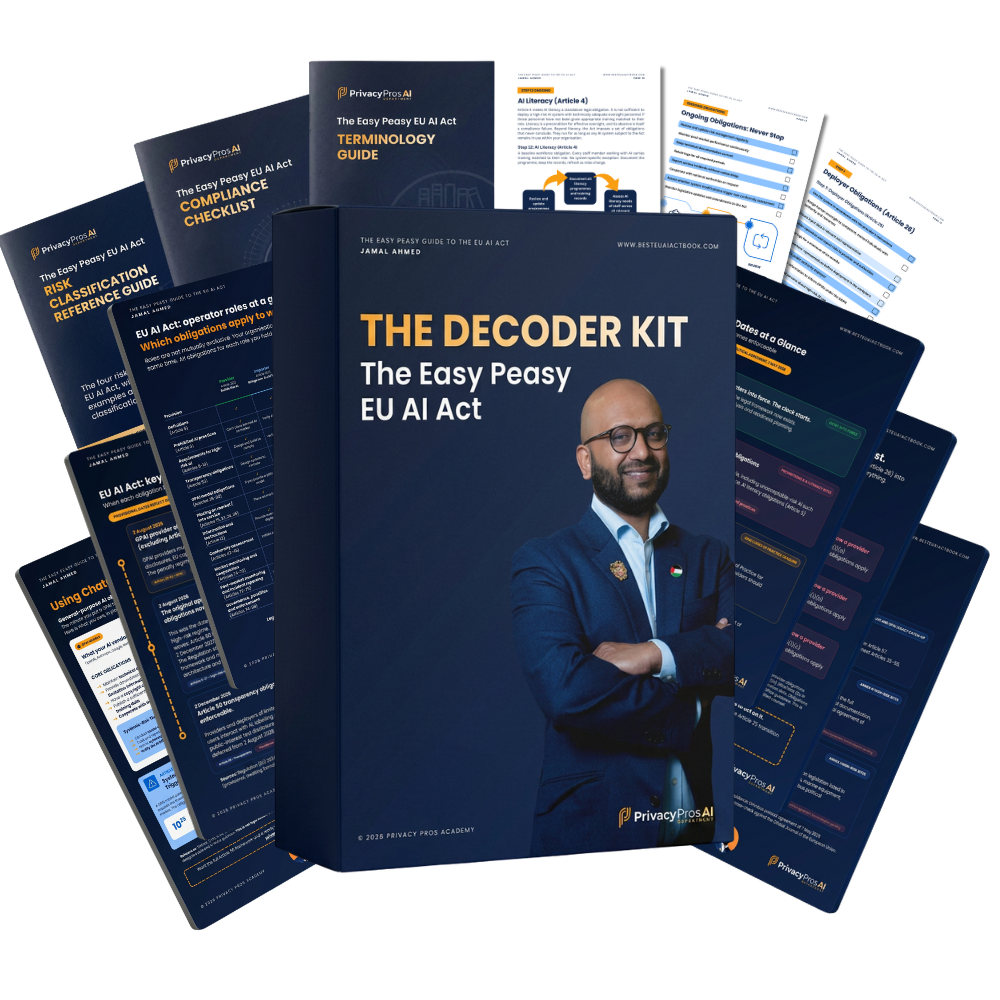
For those looking to understand the regulation before it becomes a business necessity, The Easy Peasy Guide to the EU AI Act offers an accessible starting point. The book is available for pre-order ahead of its August 3 release. To mark the launch, readers who pre-order the book can access a package of bonuses valued at £1,786, which includes additional learning resources and tools designed to support AI governance and compliance. Full details about the bonuses are available at besteuaiactbook.com.
Professionals interested in building their expertise in privacy and AI governance can also learn more through Privacy Pros Academy, connect with Jamal Ahmed on LinkedIn, or explore discussions with industry experts through the Privacy Pros Podcast and their Privacy Pros YouTube.
With enforcement now underway, understanding the rules governing AI could become one of the smartest investments professionals and organisations make.